
d or e – that is the question … when pianists sit down to play Beethoven’s “Für Elise”.
There are a great many questions surrounding Beethoven’s famous piano piece “Für Elise” – for example the identity of the lady mentioned in the title, which is even today not 100% certain, as she might have even been called Therese and not Elise … Pianists are, however, plagued by one question in particular. Why in measure 7 and analogous passages is there in some editions the root e¹ and in others – as in our current Urtext edition (HN 128) – the seventh d¹ to be found as the third from last note? And which is the right one?
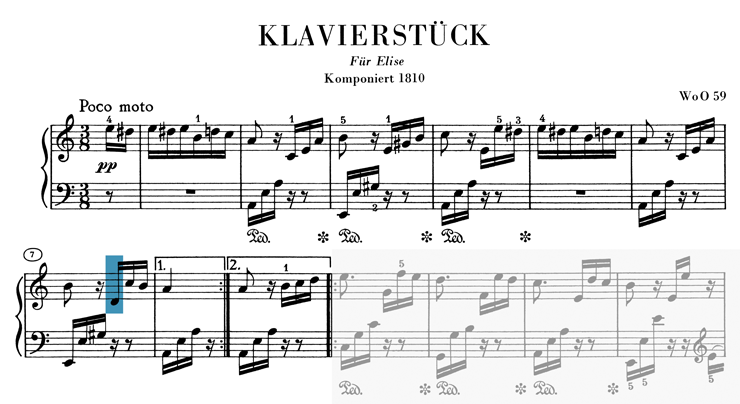
The problem is caused – as is often the case – by a contradiction in the sources: the note d¹ can be traced back to a draft Beethoven wrote for the piece that is today housed in the Beethoven-Haus Bonn :

The note e¹ on the other hand is to be found in the first printing of the piece, published long after the composer’s death by the Beethoven scholar Ludwig Nohl. He had discovered the autograph of the up-to-then unknown composition and issued the piano piece as “Für Elise” in 1867.
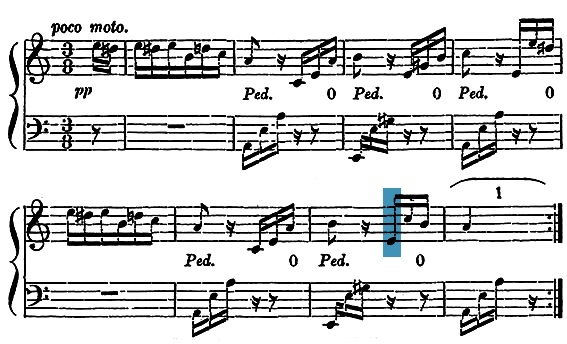
Shortly afterwards Beethoven’s manuscript disappeared once again and is still missing today – meaning that Nohl’s edition is the only testimony we have of the text in the
autograph. So we are now faced with a tricky question: If we are to believe Nohl, did Beethoven systematically replace the seventh with the root at this place in his autograph? Or did Nohl make a mistake, meaning that we should edit the text as it has been transmitted in Beethoven’s draft – that is with d¹? We decided on the latter, and are still wondering whether the autograph will reappear one day to give us the definitive answer.
Nohl’s transcription of Beethoven’s autograph is now found on IMSLP. Here the variant e-c-b-a only appears in the first page (p. 28), while in all the following repetitions of the same passage there is d-c-b-a. This seems to confirm that the correct note is D — the one you chose as well. This is also confirmed by the compositional logic, of course, as the similar melodic passages at bars 10-12 all have rising 7ths.
Very interesting stuff. I’ve always used the E, but after reading this I can see the logic in using the D. Considering the only Autograph we have of the piece is later than the autograph Nohl transcribed, I guess it makes more sense to use the D as that’s what Beethoven put. Then we also have to take into account how reliable was Nohl? The music is often heavily edited by the transcribers (look at how much Fontana would edit Chopin’s works!). I hope the first draft that was transcribed by Nohl turns up one day, it would put a lot of debate to rest.
Thank you for your interest in our blog. May I just add, that it is not the sketch of WoO 59 that is missing today (it is found in the Beethoven-Haus Bonn) but the autograph of the complete piece. This is the reason why we have to take the Nohl transcription as the basis of the edition and have to decide us to correct “his” E to D. By the way, the comparison with Fontana/Chopin is of course a very interesting one. There will be a blog on this issue in the near future!
I prefer the “D” to the “E.” Although, although my students have been bringing me many renditions of Fur Elise lately that contain the E. Overall, I wouldn’t frown at either option used by a performer. Great article and nice research.
Here’s my rendition: http://www.youtube.com/watch?v=x-O0qb66AoQ
Thanks!
Tj
Thanks Ana for the information…..next time I play this piece I shall try and observe more closely the d and e.
It’s D. First of all, there’s already are already two E’s in the l.h., so another e in the melody seems redundant. The V7 chord is more dissonant and expressive than a simple V. Not only does the D make the harmony more interesting, but the melody too, since it jumps a dissonant interval. Perhaps Nohl considered this “wrong”, being out of line with common practice, which is why he “corrected” it to E. But even more interesting, this D doesn’t resolve to the C below it. This could mean a few things, including:
1. The resolved C comes an octave too high, making the skip of a 7th – that Beethoven develops later – just a juxtaposed “step”. (If we replace the note under discussion with the D’s and E’s an octave higher, the D clearly sounds more melodic.)
2. Beethoven intentionally leaves out the C in the next chord in order to make the arrival to “C” major more gratifying, thereby anticipating the entrance of a new key.
What I personally find more interesting about the D is that even if it doesn’t really sink to the C below (or “Sea” below…ha, get it? Don’t – it’s awful), it psychologically makes the r.h. line reducible to two voices, the soprano moving C-B-A, and the alto, a sixth lower, moving E-D-C. If Nohl were correct, the alto would probably be singing E-E-E, which, again, sounds monotonous and less interesting.
Furthermore, Beethoven is clearly interested in the passionate leap of a 7th since he develops that interval further in the proceeding bars in the r.h., from G-F, F-G, etc.
My theories aside, let’s imagine that Beethoven really did want to write an E and that the D is a mistake. If so, the D that he would have written would appear very close to the intended E, since those notes are so close together on the staff anyway. Having said that, the D that Beethoven wrote doesn’t appear anywhere near the E above it. It’s not as though the ink from Beethoven’s E spilled into the D – it can’t be read as any other note. Nohl may have changed it by accident or for theoretical concerns, but whatever his reasons, he disobeyed Beethoven’s writing, and for that his choice is not “Urtext”.
I hope that my observations, humble though I admit they may be, fall under the consideration of Henle G. Verlag.
–Caleb
I take back what I said about Nohl’s writing not to be “Urtext”, since it might be based off of Beethoven’s final manuscript which is lost, but the D is still more convincing to me.
-Caleb
Thank you for this interesting ideas on the question of d and e – and as you can see from our actual edition of the piece, we do also prefer the d.
Thanks for this blog. I was confused by the D and the E in different copies. Thanks for the explanation and rationales for the D. I learned this piece playing the E but now I am starting to play it with the D. The change takes a little getting used to the different harmony.
Using D only st the end of the piece has always seemed like one of the most expressive and dramatic elements of this most beloved piece! I always thought of it as a an auditory surprise to end the music. Playing D at every point in the piece just seems to let a lot of steam out of this musical journey. Whether listening to this piece or playing it , the D at the end is what I look forward to and love more than anything else .
My thoughts exactly – one d at the end seems more dramatic and lovely.
Every musicologist loves puzzles 🙂
There’s two questions here: one is whether one of the notes is “correct.” In the absence of the final holograph, it is moot. However, even if we had B’s fair copy, the concept of the “correct” note implies that the composer never made revisions. And, since this can’t possible be true, we see the note as a variant. The player, in a performance, must choose; the editor should give an opinion as to the preferred reading. But not the correct reading, in this case.
The second question is whether one can reveal a clue by an analysis of style. In this case, we *may* have an unresolved 7th as there is no C sharp in the next chord. I say “may” because the 7th can, in a bit of a stretch, resolve melodically in the wrong octave. If one could find that resolving the note in the wrong octave was part of B’s style, that’s a nice way of supporting the choice of the”d.” In this case, we need look no further than the sequence of melodic sevenths which flows from the second ending.
I learned to play this piece as a child, from sheet music that indicated E4 in measure 7 and all analogous passages except the final one, where D4 was indicated, which seemed to give the piece a more resolute ending. I still play it this way, possibly incorrectly.
Also on that sheet music I used, the name of the piece was given as “Albumblatt,” a generic word for a short piano piece. I’ve also seen it written as “Album Leaf.” One could speculate that the name “Für Elise” was a Nohl creation, given that we don’t know of an Elise in Beethoven’s life, nor do we have the original manuscript.
It could be that the “e” was just a mistake of the engraver and not Nohl’s choise… This bar appears 3 times in the piece, why the first one with “e” and the others with “d”, for me it has no sense.
I prefer D, but I feel like the E is consistent with bar 3. Decisions decisions…
What surprises me is that no one here has suggested just following the text of the first edition verbatim, i. e. playing “e” the first time, and the somewhat more expressive “d” in all subsequent occurences of the theme. That makes perfect musical sense: Once you’ve played it with “d”, you “can’t go back”, you’ve made the step to the darker and more expressive level and you have to stick with it. For that reason, it’s musically completely convincing that it’s always “d” from the second time (not counting the initial repeat) onwards. As for the first presentation of the theme, it is also musically , or should I say “tastefully” convincing to present the musical idea at first without the dominant-seventh colour. I, personally, consider the entire discussion “is it e or is it d?” superfluous for this reason. To me, the most convincing and authentic reading is to play it exactly as written in the first edition, trusting both Nohl and Beethoven to have enough musical competence to place these notes consciously and – in Nohl’s case – correctly.
It´s interesting how everyone is wondering about D versus E, when the most striking point about the autograph is the “molto grazioso” marking. What about playing it that way instead of the languid version by Nohl ? Just for a change….