Carl Stamitz
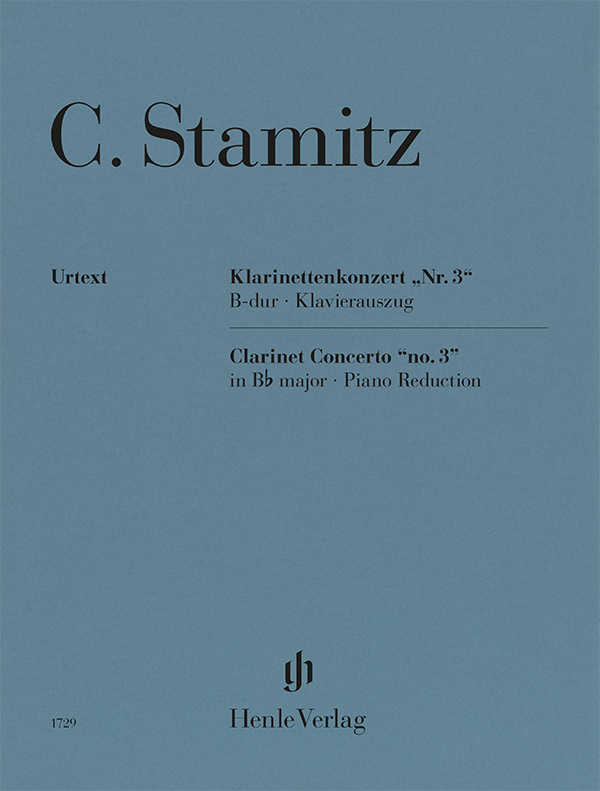
Clarinet Concerto “no. 3” B flat major
Carl Stamitz, an exceedingly productive composer of the Mannheim School, was also one of the first to provide the clarinet with numerous solo works. Of his eleven surviving clarinet concertos, the B-flat major concerto – traditionally referred to as “no. 3” – is by far the best known and most popular (according to more recent numberings, it is now considered “no. 7”). With its enchanting thematic ideas, figurations ideally suited to the clarinet, and at the same time only moderate technical demands, it has established itself throughout the world as a standard work for study. It is ideally suited as a recital piece and as a “first” solo concerto for clarinet students. As an excellent clarinettist, editor Nicolai Pfeffer has added suggestions in the solo part for sonorous, easily playable cadenzas and lead-ins. The well-set and easy-to-play piano reduction by Michail Lifits makes accompanying possible even for non-professional pianists.
About the Composer
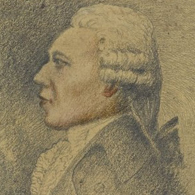
Carl Stamitz
Composer and violin virtuoso. His restless life, connected with constant changes of residence, also shaped a musical style which, while initially still indebted to the Mannheim School, increasingly strove for an internationally comprehensible musical language. As a virtuoso violinist and composer he enjoyed great success throughout Europe. He wrote a multitude of chamber music works, as well as symphonies and concerti (among other things).
| 1745 | Baptized in Mannheim on May 8. First musical instruction from his father, the violinist and composer Johann Stamitz. |
| from 1757 | Studies with Christian Cannabich, Ignaz Holzbauer and Franz Xaver Richter. |
| 1761 | Violinist with the Court Chapel. |
| from 1770 | He leaves Mannheim and travels throughout Europe. |
| 1770–1776 | Active as soloist and composer in Paris. Performances with his brother Anton as part of the Concerts spirituels. Court composer under Duke Louis de Noailles. From there, makes concert tours to Vienna, Augsburg, and other locales. |
| 1776–1780 | Active in London as musician and composer. |
| from 1780 | Travel, including to Amsterdam and The Hague. |
| from 1785 | Return to Germany (resides in Hamburg, Magdeburg, Leipzig, Berlin). Frederick William II of Prussia pledges remuneration for compositions sent to him. |
| from 1787 | Short term employment by the Prince of Hohenlohe-Schillingsfürst. Concert tours to Dresden, Prague, Halle, Nuremberg (and elsewhere). |
| 1789/90 | Employed as conductor of amateur concerts in Kassel. |
| 1795 | Moves to Jena, where he is appointed a music teacher at the university. |
| 1801 | Dies in Jena on November 9. |
About the Authors
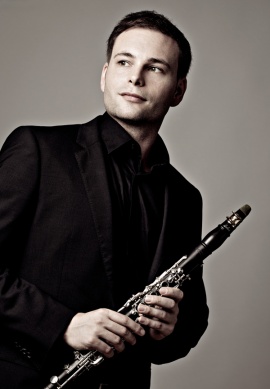
Nicolai Pfeffer (Editor, Cadenzas, Lead-ins)
Product Safety (GPSR) and Warranty

Günter Henle Verlag e.K.
Here you find information about the product’s manufacturer:Günter Henle Verlag e.K.
Forstenrieder Allee 122
81476 München
Germany
info@henle.de
www.henle.com
recommendations
autogenerated_cross_selling
Further editions of this title

Further editions of this title