Robert Schumann
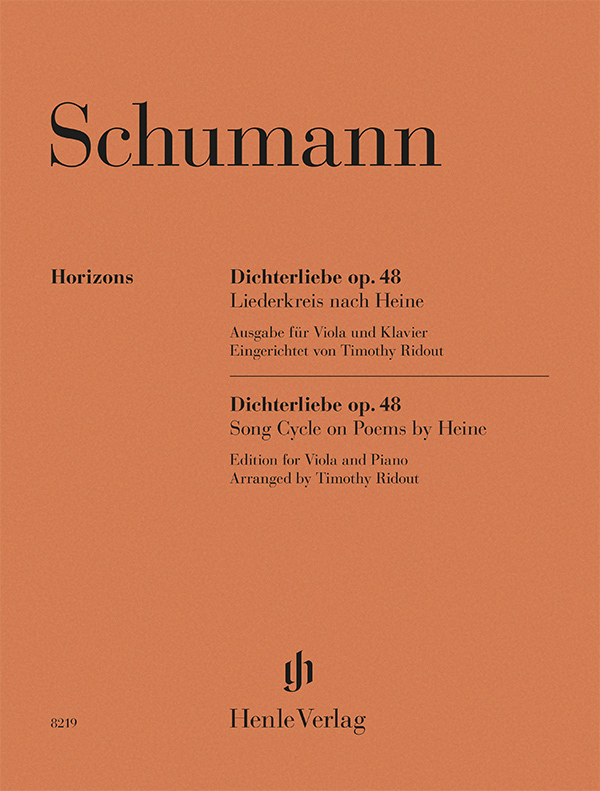
Dichterliebe op. 48
Robert Schumann’s Dichterliebe op. 48 is regarded as the epitome of Romantic art song – a cycle full of sensitive poetry and soft nuances. In his arrangement for viola, the renowned violist Timothy Ridout opens up new perspectives on Schumann’s setting of the famous song cycle with texts by Heinrich Heine. The viola takes over the vocal part with immense expressiveness and unique richness of colour, be it through ingenious octave transpositions or special effects such as “sul ponticello”. We commend this innovative yet respectful new interpretation of a Romantic masterpiece to the hearts and music stands of all viola aficionados. As always, the edition is presented in Henle’s renowned quality and with fingerings by Timothy Ridout.
About the Composer
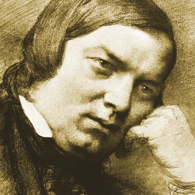
Robert Schumann
Connected with his oeuvre is the term he coined, Poetic Music, with which he strove for a fusion of literature and music, a paradigm particularly seen in his lyric piano pieces prior to 1839. Thereafter he devoted himself to other genres (song, symphony, chamber music, among others).
| 1810 | Born in Zwickau on June 8, the son of a bookdealer. |
| from 1828 | Studies law in Leipzig, piano with Friedrich Wieck. Decision to pursue a career in music. |
| 1830–39 | He exclusively composes piano works, mostly cycles, including “Papillons,” Op. 2 (1829–32); “Carnaval,” Op 9 (1834/35); “Davidsbündlertänze,” Op. 6 (1837); “Kinderszenen” (“Scenes from Childhood”), Op. 15 (1837/38); “Kreisleriana,” Op. 16 (1838); “Noveletten,” Op. 21 (1838). |
| 1832 | A paralysis of a finger in his right hand makes a career as a pianist impossible. Founding in 1833 of the fantasy brotherhood the “Davidsbund” (“League of David”). |
| 1835–44 | Editor of the Neue Zeitschrift für Musik (New Journal of Music). |
| 1840 | Marriage to Clara Wieck; 138 songs, including the Eichendorff Liederkreis, Op. 39; the song cycle “Dichterliebe,” Op. 48 |
| 1841 | Symphony No. 1 in B-flat major (“Spring” Symphony), Op. 38, and Symphony No. 4 in D minor, Op. 120. |
| 1842 | Three string quartets, Op. 41; further chamber music. |
| 1843 | Teacher of composition at the Leipzig Conservatory. Oratorio “Paradise and the Peri,” Op. 50. |
| 1845 | He settles in Dresden. Journey to Russia. |
| 1845 | Piano Concerto in A minor, Op. 54, Symphony No. 2 in C major, Op. 61. |
| 1850 | City music director in Düsseldorf. Premiere in Leipzig of his opera “Genoveva,” Op. 81. Symphony in E-flat major (“Rhenish”), Op. 97; Cello Concerto in A minor, Op. 129. |
| 1853 | Beginning of his friendship with Brahms. Completion of the Scenes from Faust. Violin Concerto in D minor for Joseph Joachim. |
| 1854 | Suicide attempt and admission to the psychiatric institution in Endenich, near Bonn. |
| 1856 | Death in Endenich on July 29. |
Product Safety (GPSR) and Warranty

Günter Henle Verlag e.K.
Here you find information about the product’s manufacturer:Günter Henle Verlag e.K.
Forstenrieder Allee 122
81476 München
Germany
info@henle.de
www.henle.com
recommendations
autogenerated_cross_selling
Further editions of this title

Further editions of this title