Johannes Brahms
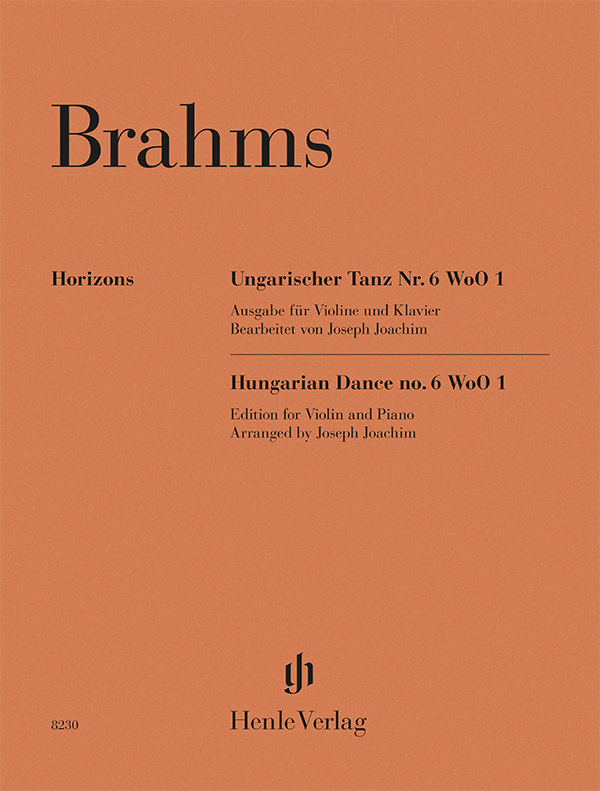
Hungarian Dance no. 6 WoO 1
“What one has so long and so boisterously merely played, is awkward to write down.” With this charming self-irony, Johannes Brahms described the lively origins of his Hungarian Dances, whose rousing rhythms and fiery melodies continue to captivate to this day. Brahms’s friend, the violinist Joseph Joachim, made a congenial arrangement for violin and piano which combines consummate virtuosity with the magic of chamber music. The refined alternation between spirited polka rhythms and elegiac “puszta” romanticism lends the Hungarian Dance no. 6 its special charm. This extremely popular dance is frequently studied on its own and is now available as a practical, affordable single edition for violin and piano. It is also ideally suited as an effective encore!
About the Composer
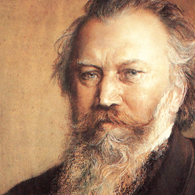
Johannes Brahms
His significant output comprises chamber music, piano works, numerous choral compositions and songs (including settings of folk-song lyrics), as well as large-scale orchestral works in the 1870s and 1880s. His compositions are characterized by the process of developing variation. He is considered an antithesis to the New German School around Liszt, and an advocate of “absolute” music.
| 1833 | Born in Hamburg on May 7, the son of a musician. His first piano instruction with Willibald Cossel at age seven, then with Eduard Marxen; first public performances from 1843. |
| 1853 | Concert tour through German cities; he meets Schumann, who announces him as the next great composer in his essay “Neue Bahnen” (“New Paths”). A lifelong, intimate friendship develops with Clara Schumann. |
| 1854–57 | Piano Concerto No. 1 in D minor, Op. 15. |
| 1857–59 | Choir director, pianist, and teacher at the royal court in Detmold. |
| 1859–61 | Director of the Hamburg Women’s Choir. |
| 1860 | Manifesto against the New Germans around Liszt. |
| 1863 | Cantata “Rinaldo,” Op. 50. |
| 1863–64 | Director of the Wiener Singakademie. |
| 1868 | Partial performance in Vienna of “A German Requiem,” Op. 45 (the complete work premiered in Leipzig in 1869) |
| 1871–74 | Artistic director of the Gesellschaft der Musikfreunde (Society of Friends of Music) in Vienna. |
| 1873 | Haydn Variations, Op. 56a, for orchestra. |
| from 1877 | His symphonic output begins with the Symphony No. 1 in C minor, Op. 68 (begun 1862); composition of the Symphony No. 2 in D major, Op. 73; the Symphony No. 3 in F major, Op. 90 (1883); and Symphony No. 4 in E minor, Op. 98 (1884–85): cantabile themes, chamber-music-like style. |
| from 1878 | Travels in Italy. |
| 1878 | Violin Concerto in D major, Op. 77, for Joseph Joachim. |
| 1881 | Piano Concerto No. 2 in B-flat major, Op. 83, with a scherzo movement. |
| 1886 | Honorary president of Vienna’s Tonkünstlerverein (Association of Musicians). |
| 1897 | Four Serious Songs, Op. 121. Dies in Vienna on April 3. |
Product Safety (GPSR) and Warranty

Günter Henle Verlag e.K.
Here you find information about the product’s manufacturer:Günter Henle Verlag e.K.
Forstenrieder Allee 122
81476 München
Germany
info@henle.de
www.henle.com
recommendations
autogenerated_cross_selling
Further editions of this title

Further editions of this title