
Sergei Rachmaninoff
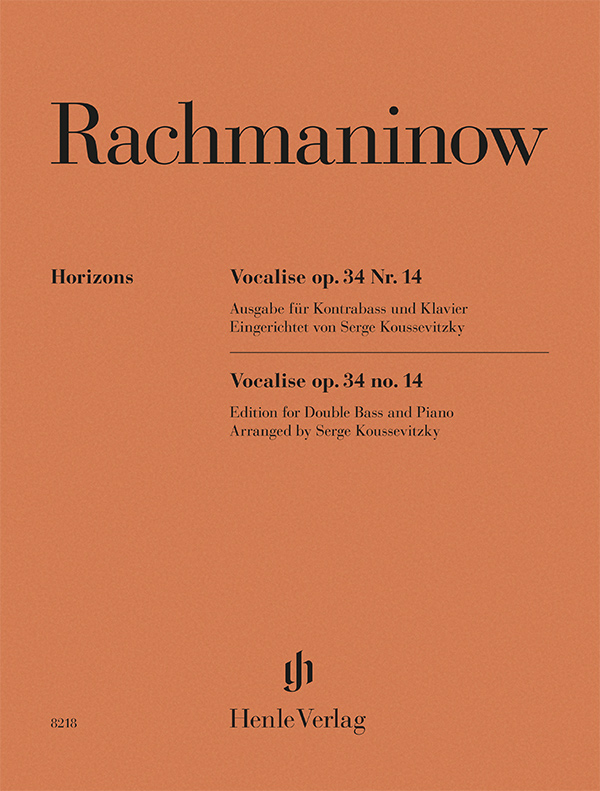
Vocalise op. 34 no. 14
Composed in 1915 for coloratura soprano Antonina Nezhdanova, Rachmaninoff’s wordless “Vocalise”, with its flowing, wistful theme, quickly became a worldwide hit. Numerous arrangements honour this unique work. The arrangement for double bass and piano stands out, not only owing to its low register: Serge Koussevitzky, double bass virtuoso and Rachmaninoff’s close friend, managed to successfully bring his arrangement, made in 1915 with the composer’s consent, to the stage even before the premiere of the original work.
Our practice-oriented edition is based on a manuscript copy carefully revised by Koussevitzky and offers, in addition to the unmarked solo part, a further version, expertly annotated by Tobias Glöckler in his tried-and-tested manner. Alongside fingerings, it also includes additional performance markings. The best premise for all low string players who wish to build upon Koussevitzky’s success!
About the Composer
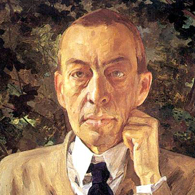
Sergej Rachmaninow
Composer and pianist who continued and expanded the late-Romantic tradition; he prepared the way for Prokofiev and Shostakovich. His oeuvre comprises orchestral works, piano pieces, choral works, several operas, and numerous songs.
| 1873 | Born in Semyonovo on April 1. From 1880 receives professional instruction in music. |
| 1885–92 | Studies music at the Moscow Conservatory. |
| 1890–92 | Piano Concerto No. 1 in F-sharp minor, Op. 1, with the diminished fourth in the main theme typical of his style. |
| 1892 | Successful performance of his one-act opera “Aleko” (a graduation work). Prelude in C-sharp minor for piano. |
| 1897 | Unsuccessful premiere of the Symphony No. 1, Op. 13 (with abrupt contrasts). First experiences as an opera conductor at Moscow’s Mamontov Theater. He becomes acquainted with Fyodor Shalyapin, later his friend. |
| 1900/01 | Composition of the Piano Concerto No. 2 in C minor, Op. 18, in a modified style (broad melodic arcs, transparent compositional style). |
| 1904–06 | Appointed conductor at the Bolshoi Theater in Moscow. |
| 1906 | Premieres of the operas “The Miserly Knight,” Op. 24, and “Francesca da Rimini,” Op. 25. |
| 1907 | Symphony No. 2 in E minor, Op. 27, with whimsical figuration in the woodwinds; Piano Sonata No. 1 in D minor, Op. 28. |
| 1909 | Piano Concerto No. 3 in D minor, Op. 30; symphonic poem “The Isle of the Dead,” Op. 29 |
| from 1910 | More complex compositional technique (enhanced polyphony, ambiguous harmonies, fast rhythmic alterations) in Thirteen Preludes for piano, Op. 32; “Études-tableaux,” Op. 33 (1911); Fourteen Songs, Op. 34 (1910–16). |
| 1917 | Rachmaninoff leaves Russia and lives in Stockholm, Copenhagen, the United States (career as pianist), and Switzerland. |
| 1926/41 | Piano Concerto No. 4 in G minor, Op. 40. In 1935/36, Symphony No. 3 in A minor, Op. 44. |
| from 1939 | He emigrates permanently to the United States. |
| 1943 | Death in Beverly Hills on March 28. |
About the Authors
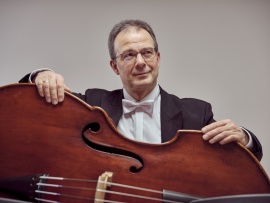
Tobias Glöckler (Fingering and bowing for Double Bass)
Tobias Glöckler is associate principal double bass player at the Dresdner Philharmonie and a prizewinner of the International ISB Double Bass Competition (USA). He studied with Konrad Siebach at the Music Conservatory in Leipzig, perfecting his skills with Jeff Bradetich (Chicago) and Ulrich Lau (Stuttgart). While studying, he was principal double bass player with the International Gustav Mahler Youth Orchestra under Claudio Abbado. He has performed as a soloist with different orchestras, including the Dresdner Philharmonie with Ton Koopman. In addition he has made recordings for radio and has made guest appearances at diverse music festivals. He is a founding member of and solo bass player with the “ensemble frauenkirche” and has explored a great many chamber music works with the Dresdner String Quintet.
Glöckler teaches at the music conservatory in Dresden. His efforts concerning the revival of the “Viennese Tuning” have been rewarded with a Distinguished Achievement Award for historical performance practice.
Photo © markenfotografie
Product Safety (GPSR) and Warranty

Günter Henle Verlag e.K.
Here you find information about the product’s manufacturer:Günter Henle Verlag e.K.
Forstenrieder Allee 122
81476 München
Germany
info@henle.de
www.henle.com
recommendations
autogenerated_cross_selling
Further editions of this title

Further editions of this title
Double bass part for solo and orchestra tuning