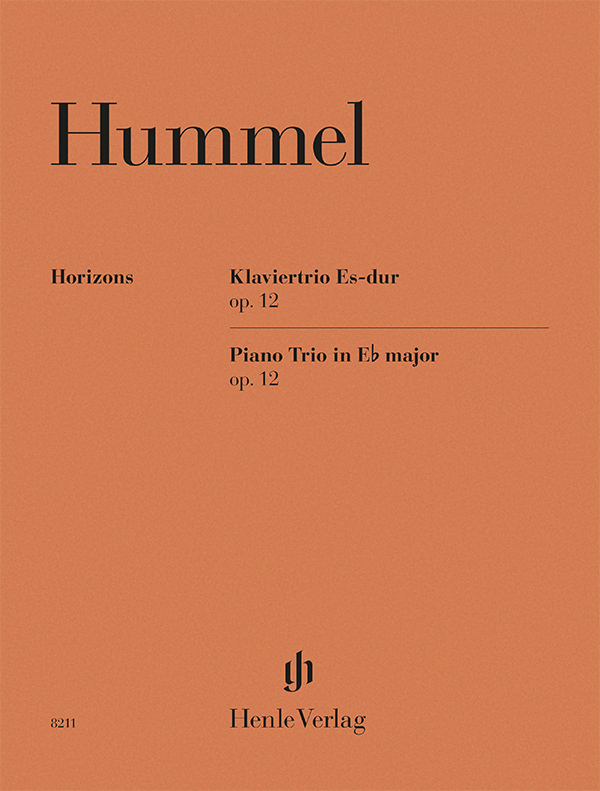
Johann Nepomuk Hummel
Piano Trio E flat major op. 12
Today, the piano trio composed in 1804 by Johann Nepomuk Hummel unjustly stands in the shadow of the great standard works of that time; yet it combines classical elegance with brilliant virtuosity. Skilful thematic development, harmonic audacity and technical subtleties unite to create a chamber-music showpiece. Dazzling octave runs, fast chord arpeggiations and trills in the piano require great dexterity – true virtuoso fodder for advanced ensembles. The Henle edition presents the work in clearly comprehensible musical notation with balanced page layout and convenient page turns – making rehearsals a real pleasure!
About the Composer
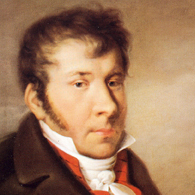
Johann Nepomuk Hummel
Composer and pianist, whose works are positioned stylistically at the transition from Classicism to Romanticism. They encompass nearly all genres, including six piano concerti, sonatas, chamber music, incidental music, and sacred works. Admired as a virtuoso during his lifetime, he showed his technical skills in a comprehensive course on the art of piano playing. He was a member of the Institut de France and the Gesellschaft der Musikfreunde (Society of Friends of Music) in Vienna, among others.
| 1778 | Born in Pressburg (Bratislava) on November 14. His father, a professional musician, gives him his first music lessons. |
| 1786–88 | The family relocates to Vienna, where he becomes the pupil of Wolfgang Amadeus Mozart. |
| 1788–93 | With his father he undertakes a multi-year concert tour through Europe. In London he meets Joseph Haydn. |
| from 1793 | Back in Vienna, he becomes the pupil of Johann Georg Albrechtsberger, Antonio Salieri, and Joseph Haydn. |
| 1804–11 | He is concertmaster of Prince Esterházy’s orchestra in Eisenstadt. |
| from 1811 | In Vienna he devotes himself primarily to composition and teaching. |
| 1813 | He marries Elisabeth Röckel, a singer at Vienna’s Hoftheater. |
| 1816–18 | He is Royal Württemberg Court Music Director in Stuttgart. |
| from 1819 | In February he becomes court music director in Weimar, and rises to become one of that city’s most important musical figures. |
| 1827 | In Vienna he meets Franz Schubert. He participates in the funeral of Ludwig van Beethoven. |
| 1828 | He publishes his Course of Instruction on the Art of Playing the Piano, which he had drafted in Weimar. |
| 1831 | With André Hippolyte Chelard he directs the Thuringia Music Festival in Erfurt. |
| 1837 | Dies in Weimar on October 17. |
Product Safety (GPSR) and Warranty

Günter Henle Verlag e.K.
Here you find information about the product’s manufacturer:Günter Henle Verlag e.K.
Forstenrieder Allee 122
81476 München
Germany
info@henle.de
www.henle.com
recommendations
autogenerated_cross_selling