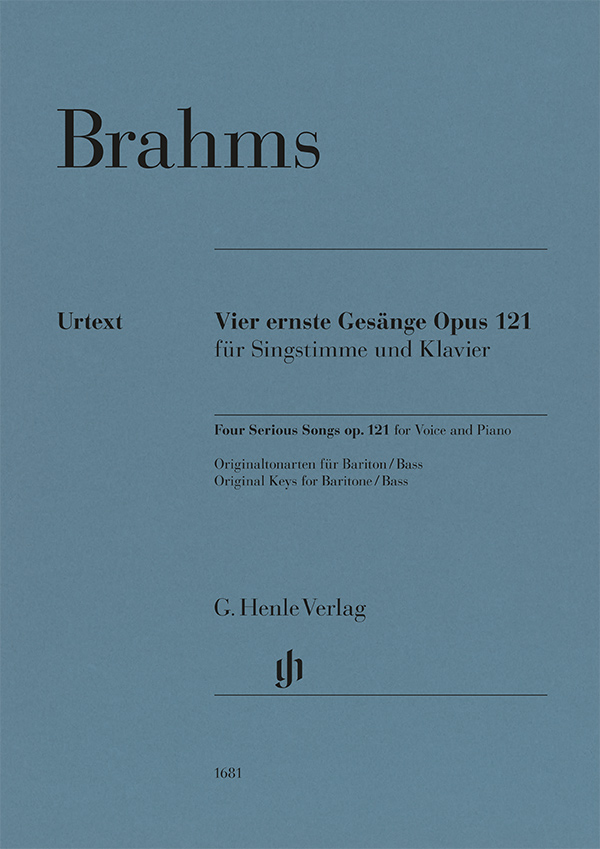
Johannes Brahms
Four Serious Songs op. 121 for Voice and Piano
The Four Serious Songs, op. 121, was to be the last work Brahms published before his death. These songs are closely linked to the death of his beloved friend Clara Schumann in May 1896. It is reported that after her funeral, Brahms, in tears, performed the songs in the circle his friends. When the composer himself died shortly thereafter, in April 1897, the Four Songs were transformed into his own musical memorial. Owing to their musical expressive power and poignancy, these songs for low voice, based on verses from the Old and New Testaments, number among the milestones in the Romantic song repertoire to the present day – be it in lessons or on the concert stage.
The Henle Urtext edition offers the scholarly verified musical text of the New Brahms Complete Edition. In the preface, editor Johannes Behr presents interesting insights into the genesis and early reception of the pieces.
About the Composer
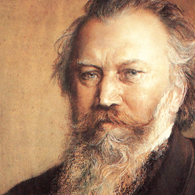
Johannes Brahms
His significant output comprises chamber music, piano works, numerous choral compositions and songs (including settings of folk-song lyrics), as well as large-scale orchestral works in the 1870s and 1880s. His compositions are characterized by the process of developing variation. He is considered an antithesis to the New German School around Liszt, and an advocate of “absolute” music.
| 1833 | Born in Hamburg on May 7, the son of a musician. His first piano instruction with Willibald Cossel at age seven, then with Eduard Marxen; first public performances from 1843. |
| 1853 | Concert tour through German cities; he meets Schumann, who announces him as the next great composer in his essay “Neue Bahnen” (“New Paths”). A lifelong, intimate friendship develops with Clara Schumann. |
| 1854–57 | Piano Concerto No. 1 in D minor, Op. 15. |
| 1857–59 | Choir director, pianist, and teacher at the royal court in Detmold. |
| 1859–61 | Director of the Hamburg Women’s Choir. |
| 1860 | Manifesto against the New Germans around Liszt. |
| 1863 | Cantata “Rinaldo,” Op. 50. |
| 1863–64 | Director of the Wiener Singakademie. |
| 1868 | Partial performance in Vienna of “A German Requiem,” Op. 45 (the complete work premiered in Leipzig in 1869) |
| 1871–74 | Artistic director of the Gesellschaft der Musikfreunde (Society of Friends of Music) in Vienna. |
| 1873 | Haydn Variations, Op. 56a, for orchestra. |
| from 1877 | His symphonic output begins with the Symphony No. 1 in C minor, Op. 68 (begun 1862); composition of the Symphony No. 2 in D major, Op. 73; the Symphony No. 3 in F major, Op. 90 (1883); and Symphony No. 4 in E minor, Op. 98 (1884–85): cantabile themes, chamber-music-like style. |
| from 1878 | Travels in Italy. |
| 1878 | Violin Concerto in D major, Op. 77, for Joseph Joachim. |
| 1881 | Piano Concerto No. 2 in B-flat major, Op. 83, with a scherzo movement. |
| 1886 | Honorary president of Vienna’s Tonkünstlerverein (Association of Musicians). |
| 1897 | Four Serious Songs, Op. 121. Dies in Vienna on April 3. |
Product Safety (GPSR) and Warranty
G. Henle Verlag
Here you find information about the product’s manufacturer:G. Henle Verlag e.K.
Forstenrieder Allee 122
81476 München
Germany
info@henle.de
www.henle.com
推荐
autogenerated_cross_selling