Sergei Prokofiev
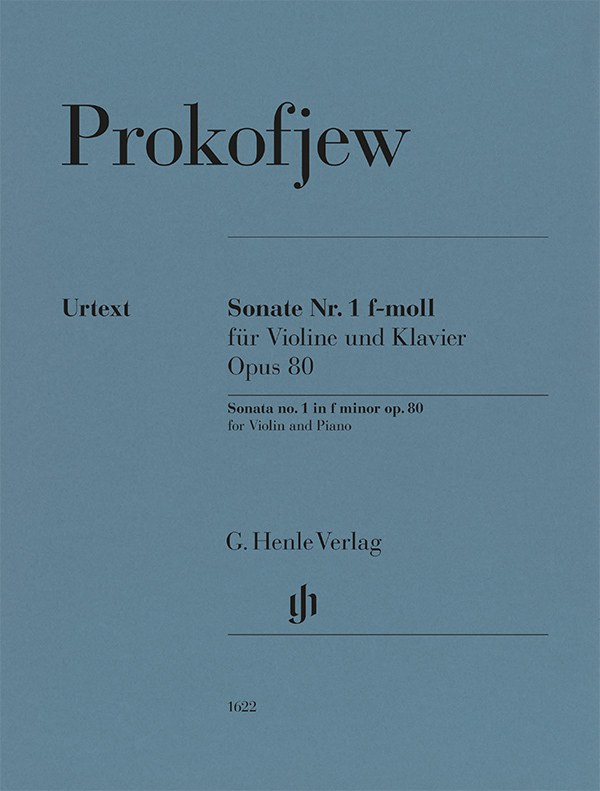
Sonata no. 1 f minor op. 80 for Violin and Piano
Sergei Prokofiev began work on his first violin sonata in 1938, but was only able to complete it in 1946, after the end of the war. He was encouraged to do so by violinist David Oistrakh, who two years earlier had already collaborated on the reworking of Prokofiev’s Flute Sonata op. 94 into a violin sonata. The repressive political situation in the Soviet Union and the harsh years of war left their mark on the very sombre overall character of the Violin Sonata op. 80: Thus, Prokofiev described the ghostly pianissimo runs in the violin in the first movement as the “evening autumn wind that blows over deserted graves”.
The editor of our new Urtext edition is the violinist and musicologist Viktoria Zora, who has researched and written about Prokofiev’s violin sonatas for many years. She has examined all the original sources in Russian and international archives. Thus, for the first time it has been possible to make a source-critical edition of the sonata that eliminates the many errors and ambiguities of earlier editions. The informative preface by Simon Morrison, the world’s leading Prokofiev specialist, sheds light on the genesis and early reception of this expressive work.
About the Composer
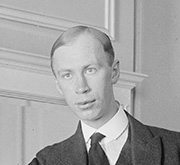
Sergej Prokofjew
Together with Shostakovich, Prokofiev is the Soviet Union’s most important composer. He left behind a
wide-ranging oeuvre from the most modern to neo-classically simple works, from
propagandistic commissions to compositions that the CPSU rejected as being formalistic.
| 1891 | Prokofiev is born on 23 April in Sontsovka (Ukraine), the son of a farmer. |
| 1904–14 | He studies at the St. Petersburg Conservatory. |
| from 1908 | He is a member of the circle around Serge Diaghilev, who occupies himself intensively with contemporary music. |
| 1911–18 | Avantgarde compositions such as Sarcasms, the Piano Concertos nos. 1 and 2, “Visions fugitives”, “Scythian Suite” are dismissed as being futuristic. |
| 1916–17 | The “Symphonie Classique”, drawing on classical models, brings him international renown. |
| 1918 | Prokofiev leaves the Soviet Union and travels to the USA, where his opera “The Love for Three Oranges” is performed in Chicago, and then travels to Paris in 1922. He enjoys a close cooperation with Diaghilev and writes ballet compositions. |
| 1919–23 | He composes the opera “The Fiery Angel”, which receives its first performance posthumously in Venice in 1954. |
| 1923–25 | The composer continues to develop his avantgarde musical language, for instance in the 2nd Symphony. |
| 1927 | He enjoys a successful concert tour around the Soviet Union. |
| 1929 | “The Gambler” is premiered in Brussels. |
| 1936 | Prokofiev returns to his home country. He writes compositions in line with the cultural ideology of the Soviet Union. He turns towards a simpler music as early as the beginning of the 1930s. “Peter and the Wolf” is composed. |
| 1946 | “The Engagement in the Monastery” is performed in Prague and “War and Peace” in Leningrad. |
| 1948 | He is accused of formalism. |
| 1953 | Prokofiev
dies on 5 March in Moscow. |
Product Safety Informations (GPSR)
G. Henle Verlag
Here you can find the information about the manufacturer of the product.G. Henle Verlag e.K.
Forstenrieder Allee 122
81476 München
Germany
info@henle.de
www.henle.com
推荐
autogenerated_cross_selling
本书目其他版本