

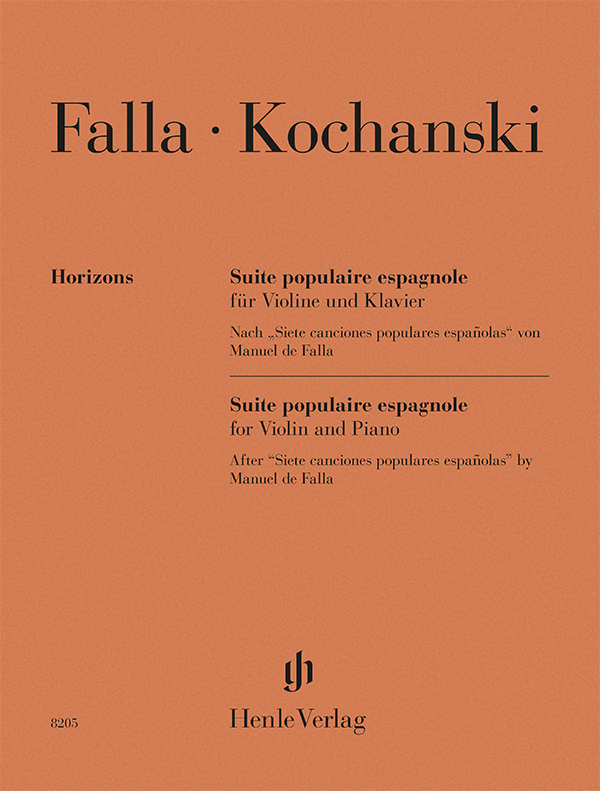
Paul Kochanski
Suite populaire espagnole
The “Suite populaire espagnole” by violin virtuoso Paul Kochanski combines characteristic Spanish rhythms with the finest chamber music elegance. The basis is Falla’s song cycle “Siete canciones populares españolas” from 1914 – a masterpiece between folk art and art music, which blends folkloristic timbres with impressionistic harmonies. Paul Kochanski’s dazzling arrangement from 1926 plays with violin techniques such as pizzicato to evoke the castanets in “Jota” or muted strings in “Asturiana”. The Henle edition offers clear musical notation and is the ideal starting point for a performance of these Spanish impressions.
About the Composer
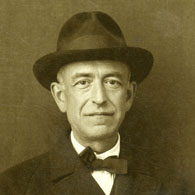
Manuel de Falla
Spain’s most important composer of the twentieth century; he absorbed prevailing trends from the Parisian avant-garde and combined them with nationalist Spanish ideas.
| 1876 | Born in Cádiz on November 23, the son of a businessman. |
| 1896–99 | Piano studies at the conservatory in Madrid; from 1902–1904, private lessons with Spanish nationalist Felipe Pedrell. |
| 1906–08 | “4 Piezas españolas” for piano. |
| 1906 | With his opera “La vida breve,” Falla wins a competition to promote Spanish nationalist operas. |
| 1907 | Relocation to Paris, acquaintance with Dukas, Debussy, Ravel, Albéniz. He is introduced to the circle of the “Apaches,” to which Ravel, among others, belongs. |
| 1909 | Songs “Tres melodías” after Théophile Gautier. |
| 1909–15 | “Noches en los jardines de España” (“Nights in the Garden of Spain”) for piano and orchestra, including Andalusian folklore elements. |
| 1913 | Premiere in Nice of “La vida breve.” |
| 1914 | Return to Madrid upon the outbreak of the world war. “Las Siete cancíones populares españolas” after texts of old Spanish songs. |
| 1915 | Premiere of the ballet “El amor brujo.” |
| 1919 | Breakthrough with the premiere in London of the ballet “El sombrero de tres picos” (“The Three-Cornered Hat”). |
| 1920 | “Homenaje: pièce de guitare écrite pour ‘Le Tombeau de Claude Debussy’” (“Homage: Guitar Piece Written for ‘Le Tombeau de Claude Debussy’”). He moves to Granada; there he explores flamenco and popular puppet theater with Federico García Lorca. |
| 1923 | Premiere in Paris of the puppet opera “El retablo de maese Pedro” (“Master Pedro’s Puppet Show”) after an episode in Don Quixote. |
| 1923–26 | Concerto for harpsichord and five instruments. |
| 1927–46 | Composition of the scenic cantata “Atlántida”: a monumental work completed by his student Ernesto Halffter and premiered posthumously in Barcelona in 1961 (in concert version) and in Milan in 1962. |
| 1939 | Relocation to Argentina. |
| 1946 | Death in Alta Gracia (Argentina) on November 14. |
Product Safety (GPSR) and Warranty

Günter Henle Verlag e.K.
Here you find information about the product’s manufacturer:Günter Henle Verlag e.K.
Forstenrieder Allee 122
81476 München
Germany
info@henle.de
www.henle.com