Sergei Prokofiev
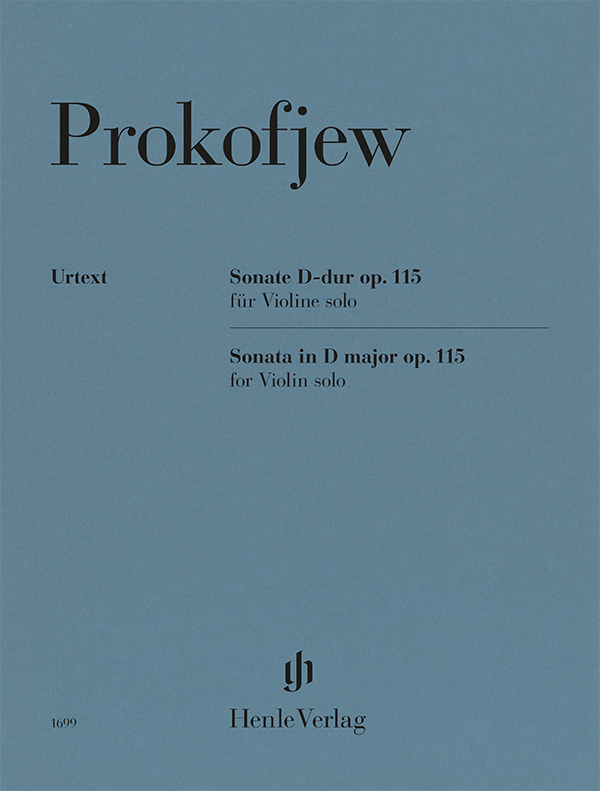
Sonata for Violin solo D major op. 115
Prokofiev’s Violin Sonata op. 115 was composed in the summer of 1947 as a commission for the Soviet Committee for Artistic Affairs, which had requested a pedagogical work for young violin students. The three-movement solo sonata composed in accordance with these stipulations therefore displays only intermediate technical difficulty and a moderate length yet is unmistakably “genuine” Prokofiev. Thus, it has established itself both as a very popular piece for violin study and as a shorter recital piece for professionals.
This first Urtext edition provides a scholarly well-founded musical text based on the autograph and the Soviet first edition of 1952 – prepared optimally for performance:
fold-out pages enable smooth page turns; the excellent violinist Tianwa Yang provides helpful fingerings. Henle thus offers the ideal foundation for studying the sonata.
The informative preface by the world’s leading Prokofiev specialist Simon Morrison
reveals interesting details about the work’s genesis.
About the Composer
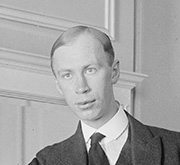
Sergej Prokofjew
Together with Shostakovich, Prokofiev is the Soviet Union’s most important composer. He left behind a
wide-ranging oeuvre from the most modern to neo-classically simple works, from
propagandistic commissions to compositions that the CPSU rejected as being formalistic.
| 1891 | Prokofiev is born on 23 April in Sontsovka (Ukraine), the son of a farmer. |
| 1904–14 | He studies at the St. Petersburg Conservatory. |
| from 1908 | He is a member of the circle around Serge Diaghilev, who occupies himself intensively with contemporary music. |
| 1911–18 | Avantgarde compositions such as Sarcasms, the Piano Concertos nos. 1 and 2, “Visions fugitives”, “Scythian Suite” are dismissed as being futuristic. |
| 1916–17 | The “Symphonie Classique”, drawing on classical models, brings him international renown. |
| 1918 | Prokofiev leaves the Soviet Union and travels to the USA, where his opera “The Love for Three Oranges” is performed in Chicago, and then travels to Paris in 1922. He enjoys a close cooperation with Diaghilev and writes ballet compositions. |
| 1919–23 | He composes the opera “The Fiery Angel”, which receives its first performance posthumously in Venice in 1954. |
| 1923–25 | The composer continues to develop his avantgarde musical language, for instance in the 2nd Symphony. |
| 1927 | He enjoys a successful concert tour around the Soviet Union. |
| 1929 | “The Gambler” is premiered in Brussels. |
| 1936 | Prokofiev returns to his home country. He writes compositions in line with the cultural ideology of the Soviet Union. He turns towards a simpler music as early as the beginning of the 1930s. “Peter and the Wolf” is composed. |
| 1946 | “The Engagement in the Monastery” is performed in Prague and “War and Peace” in Leningrad. |
| 1948 | He is accused of formalism. |
| 1953 | Prokofiev
dies on 5 March in Moscow. |
About the Authors
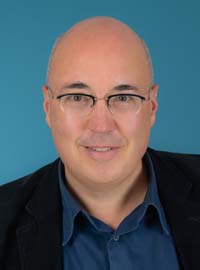
Dominik Rahmer (Editor)
Dr. Dominik Rahmer, born in 1971 in Mainz, studied musicology, philosophy and maths in Bonn. He did his Magister Artium in 1999 and his doctorate in 2006 with a thesis on the music criticism of Paul Dukas.
From 2001 to 2011 he was employed at Boosey & Hawkes/Bote & Bock in Berlin, where he also worked on the Critical Edition of the Works of Jacques Offenbach (OEK). Since 2011 he has been an editor at Henle Publishers in Munich, with a particular focus on French and Russian music and works for wind instruments.
Product Safety (GPSR) and Warranty

Günter Henle Verlag e.K.
Here you find information about the product’s manufacturer:Günter Henle Verlag e.K.
Forstenrieder Allee 122
81476 München
Germany
info@henle.de
www.henle.com
推荐
autogenerated_cross_selling
本书目其他版本