Erwin Schulhoff
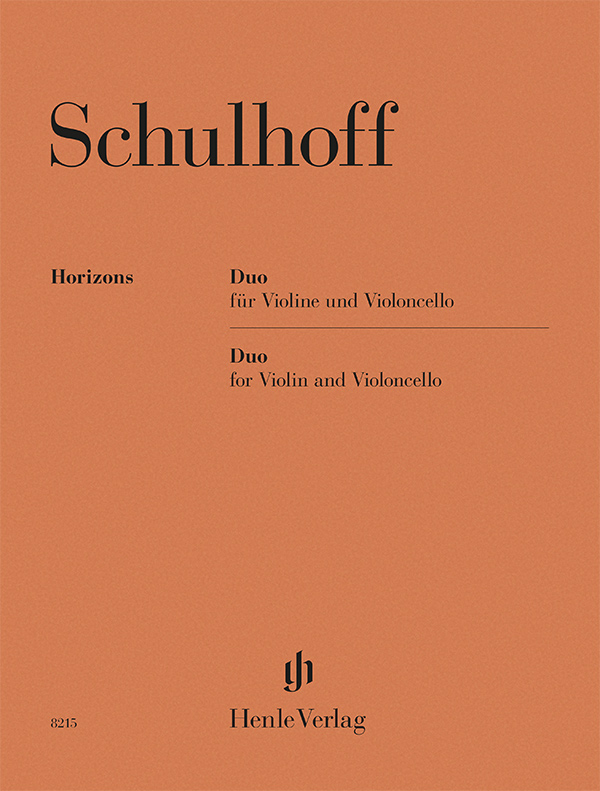
Duo for Violin and Violoncello
Erwin Schulhoff’s String Duo for Violin and Cello, composed in 1925, is the perfect example of the modern, adventurous compositional style of the “Roaring Twenties”. In this radical work, the Czech-Jewish composer combined dissonant modern, jazz elements and Dada influences. The four movements (Allegro risoluto, Foxtrot, Musette and Perpetuum mobile) are virtuoso, provocative and timeless.
The Henle edition invites you to explore the work: based on the first edition, it offers a clear, modern engraving in two performance scores – providing maximum clarity for those wishing to delve into the beginnings of modern music in the twentieth century.
About the Composer
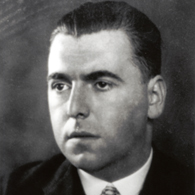
Erwin Schulhoff
A Bohemian composer and pianist, whose works reflect all the musical currents of his age: thus one may find jazz, trendy dances like the Charleston, neoclassicism, and Dadaism in them. He achieved great success as a concert and radio pianist. His compositional oeuvre includes stage works, songs, works for orchestra, chamber music, and piano pieces.
| 1894 | Born in Prague on June 8. |
| 1901 | On the recommendation of Antonín Dvořák he receives piano instruction from Heinrich von Kaan-Albest, director of the Prague Conservatory. |
| 1904 | He studies at the Prague Conservatory. |
| 1906 | He becomes a pupil of Willy Thern. |
| 1908 | On June 8 he matriculates at the Leipzig Conservatory. |
| 1909 | He is accepted into Max Reger’s composition studio. |
| 1911 | At the Cologne Conservatory he deepens his studies comprehensively, e.g., in piano, counterpoint, orchestration, composition, and conducting. |
| 1913 | He is awarded the Wüllner Prize and the Mendelssohn Prize. |
| 1918 | He receives the Mendelssohn Prize for a second time, this time for his String Quartet, op. 25. He is accompanist at the Cologne Opera. |
| from 1919 | He lives in Dresden with his sister, in whose studio a group of artists regularly gathers. |
| 1920–22 | Teaches at the conservatory in Saarbrücken. |
| 1924 | He is the music correspondent for the Prague Abendblatt (evening newspaper). |
| 1935–39 | He works as a radio pianist in Mährisch-Ostrau (Ostrava). Because of his Jewish heritage he loses his job. |
| 1941 | On June 23 he and his son are arrested during the German invasion. |
| 1942 | Dies in the Wülzburg internment camp on August 18. |
Product Safety (GPSR) and Warranty

Günter Henle Verlag e.K.
Here you find information about the product’s manufacturer:Günter Henle Verlag e.K.
Forstenrieder Allee 122
81476 München
Germany
info@henle.de
www.henle.com
recommendations
autogenerated_cross_selling