Frédéric Chopin
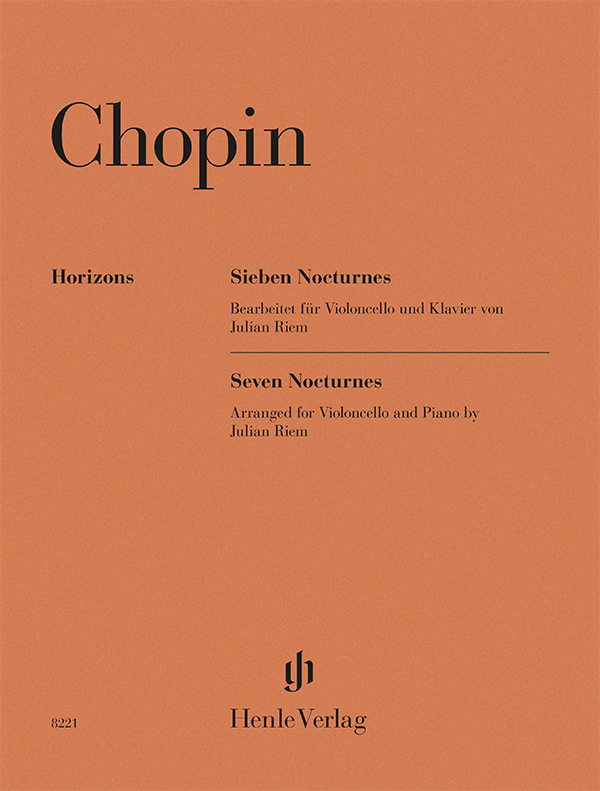
Seven Nocturnes
Frédéric Chopin’s Nocturnes number among the most intimate and at the same time most artistic examples of Romantic piano poetry. Composed between 1830 and 1846, they reflect Chopin’s mature expressive ideal: songful melodies, subtle harmonies and intimate timbres. Already shortly after their first publication in Paris, these lyrical miniatures found widespread circulation throughout Europe. In 2024 the award-winning pianist Julian Riem presented a few of the Nocturnes in a tonally sensitive arrangement for violoncello and piano, with which the duo Raphaela Gromes and Olga Scheps delighted their audience – a CD recording was not long in coming. The Henle edition provides the musical text of this wonderful selection, ranging from the moving cantabile of the famous E-flat major Nocturne op. 9 no. 2 to the subtly shaded sound structures of the late opus 62 – an invitation to rediscover the Nocturnes through the dialogue between cello and piano!
About the Composer
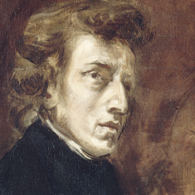
Frédéric Chopin
Pianist and composer. His work is concentrated around piano music that enjoys extraordinary popularity and has become an integral part of the concert repertoire. His music influenced subsequent generations in France (Franck, Saint-Saëns, Fauré, Debussy) as well as Smetana, Dvořák, Balakirev, Grieg, Albéniz.
| 1810 | Born in Żelazowa Wola near Warsaw on March 1. First compositions at age seven, his first public performance at eight. |
| 1822 | Private instruction in composition. |
| 1825 | Rondo in C minor, Op. 1, his first published work. |
| 1826–29 | Studies at the Institute of Music in Warsaw. |
| 1829 | “Fantaisie sur des airs nationaux polonaise” in A major, Op. 13; Piano Trio in G minor, Op. 8. Travels to Vienna, where he gives two concerts of his compositions and improvisations. |
| 1829–33 and 1835–37 | Etudes, Opp. 10 and 25 -- a new type of virtuosic etude that also makes aesthetic demands. |
| 1830 | Premieres in Warsaw of his two piano concerti, Op. 21 in F minor and Op. 11 in E minor. |
| 1831 | Unable to return to Warsaw due to the Polish uprising, he goes to Paris, where he will remain until the end of his life. |
| 1832 | Debut concert in Paris to great acclaim. |
| 1835/38 | “Trois valses brillantes,” Op. 34. |
| 1836/39 | “24 Preludes,” Op. 28, in a cyclic succession: compactly-designed short pieces. |
| 1835/39 | Piano Sonata in B-flat minor, Op. 35, with the funeral march. |
| 1842/43 | Ballade No. 4 in F minor, Op. 52; “Grande Polonaise brillante” in A-flat major, Op. 53; Scherzo No. 4 in E major, Op. 54. |
| 1844 | Piano Sonata in B minor, Op. 58 |
| 1849 | Completion of the mazurkas in G minor and F minor. Death in Paris on October 17. |
Product Safety (GPSR) and Warranty

Günter Henle Verlag e.K.
Here you find information about the product’s manufacturer:Günter Henle Verlag e.K.
Forstenrieder Allee 122
81476 München
Germany
info@henle.de
www.henle.com
recommendations
autogenerated_cross_selling
Further editions of this title