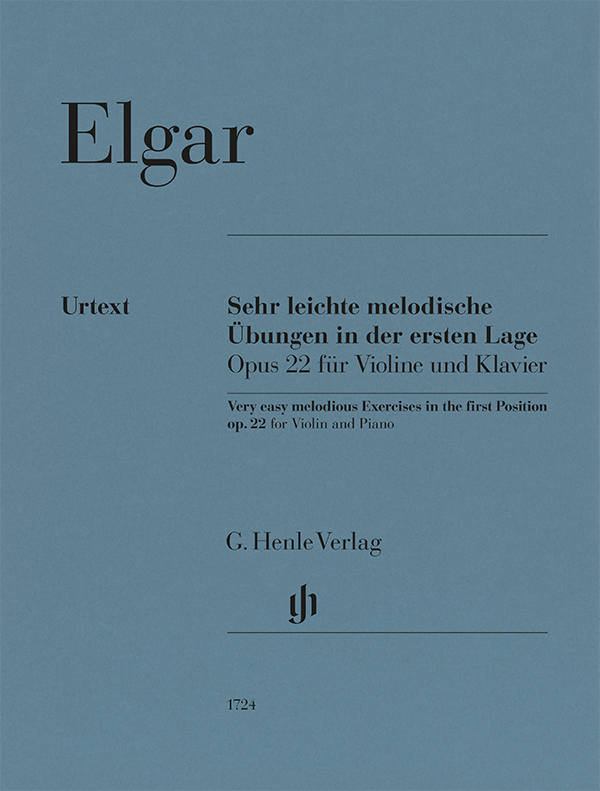
Edward Elgar
Very Easy Melodious Exercises in the First Position op. 22 for Violin and Piano
After Elgar achieved huge success with the publication of Salut d’amour, in 1889 he attempted to establish himself in London and to live as a freelance artist. However, he was not able to gain a proper foothold, which is why the Elgars moved back to the countryside in Malvern in 1891. There, the composer had a steady flow of students and was able to make a good living as a violin teacher. The Very Easy Melodious Exercises for violin and piano date from this time. Originally composed for his niece, May Grafton, they reflect Elgar’s renewed interest in teaching. Traces of this activity are displayed in the autograph, which was apparently used in violin lessons and contains numerous fingerings that are missing from the edition published in 1892. In his Urtext edition, British Elgar expert and violinist Rupert Marshall-Luck documents these details in his usual meticulous manner, and in this way creates a newly verified musical text of this classic for violin teaching.
About the Composer
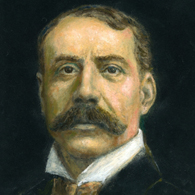
Edward Elgar
Most important English composer of his day. His immense oeuvre comprises numerous choral works, songs with piano and orchestral accompaniment, several stage works, orchestral music of a mostly programmatic character, a few works of chamber music in his last phase, and works for piano and organ.
| 1857 | Born in Broadheath (Worcester) on June 2, the son of a music dealer. First attempts at composition at ten years of age. He is largely an autodidact with rich practical experience. |
| from mid-1870 | He plays in various orchestras in Worcester, including the Worcester Philharmonic Society as well as the Festival Orchestra (under the direction of A. Dvořák and others). From 1878 some of his compositions are performed (sometimes for the first time). |
| from 1882 | He serves variously as conductor of the Worcester Amateur Instrumental Society and the newly founded Worcestershire Philharmonic Society (1889–1904). |
| 1889 | Moves to London. |
| 1889–1903 | Cantata, “The Black Knight,” Op. 25. |
| 1890 | Premiere of the overture “Froissart,” Op. 19, as his first major work. |
| 1891 | Moves to Malvern; activities in the countryside. |
| 1896 | Oratorio, “The Light of Life (Lux Christi),” Op. 29. |
| 1897–99 | “Sea-Pictures,” Op. 37, for contralto and orchestra. |
| after 1897 | He composes works for ceremonial occasions for the English royal court. |
| 1898–99 | Enigma Variations, Op. 36, a musical portrayal of fourteen of his friends. |
| 1899–1900 | Oratorio, “The Dream of Gerontius,” Op. 38, serves as a watershed moment. He receives numerous honors, including honorary doctorates in 1900 and 1907, and in 1911 the Order of Merit. |
| 1901–06 | Oratorios “The Kingdom,” Op. 51, and “The Apostles,” Op. 49. |
| 1904–08 | Professorship at the University of Birmingham. |
| 1908 | Premiere of his Symphony No. 1 in A-flat major, Op. 55; the pinnacle of his success, with 84 performances by 1909. |
| 1909/10 | Violin Concerto in B minor, Op. 61, the first significant English concerto. |
| 1911 | Premiere of his Symphony No. 2 in E-flat major, Op. 63, enjoys little success. |
| 1912 | He moves to London. |
| 1913 | Symphonic study, “Falstaff,” Op. 68. |
| 1918 | Chamber music works, including the Sonata for Violin and Piano in E minor, Op. 82; the String Quartet in E minor; the Piano Quintet in A minor. |
| 1918–19 | Cello Concerto in E minor, Op. 85, a late magnum opus. |
| 1934 | Dies in Worcester on February 23. |
Product Safety Informations (GPSR)

G. Henle Verlag
Here you can find the information about the manufacturer of the product.G. Henle Verlag e.K.
Forstenrieder Allee 122
81476 München
Germany
info@henle.de
www.henle.com
recommendations
autogenerated_cross_selling
Further editions of this title

Further editions of this title