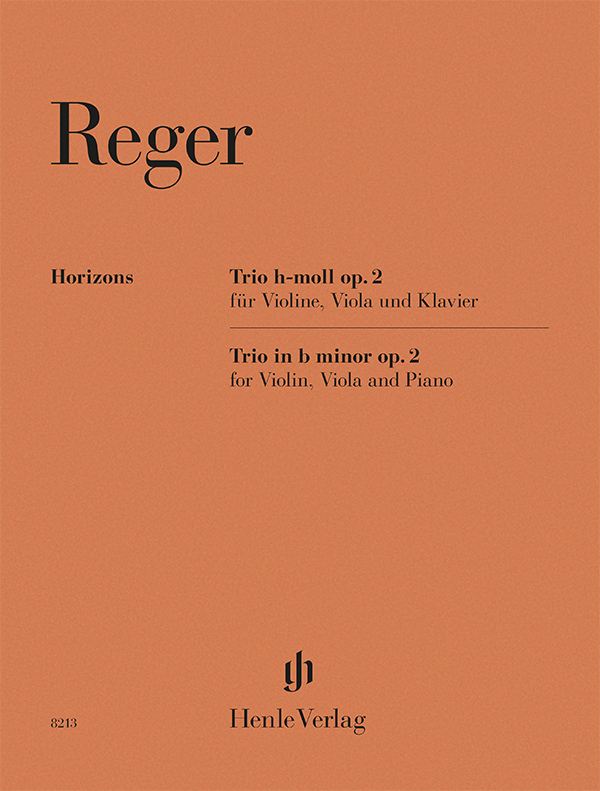
Max Reger
Trio b minor op. 2 for Violin, Viola and Piano
Horizons, paperbound
Piano Trios
ページ数 51 (III+32+8+8),
大きさ 23,5 x 31,0 cm
HN 8213
·
ISMN 979-0-2018-8213-0
Max Reger’s Piano Trio in b minor op. 2, unusually scored for viola instead of violoncello, is a passionate early work in which the entire harmonic audacity and expressive depth of the young Reger are already apparent. Alternating between dramatic energy and lyrical intimacy, a chamber music masterpiece unfolds which demands great technical precision as well as sensitive ensemble playing.
もっと読む
作曲家について
もっと読む ...
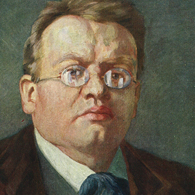
Max Reger
Late-Romantic composer who combines a chromatic tonal language with Baroque and Classical forms, thus anticipating 1920s neoclassicism.
| 1873 | Born in Brand (Upper Palatinate) on March 19, the son of a teacher. First piano lessons from his mother. |
| 1888 | After a visit to Bayreuth (for Meistersinger and Parsifal), decides on a career in music. |
| 1890–93 | Studies with Hugo Riemann at the conservatory in Wiesbaden, composes chamber works. Thereafter he endeavors to publish his own works as a freelance composer, albeit with multiple failures. |
| 1898 | Return to his parents’ home in Weiden. Composition of organ works: choral fantasies, “Fantasy and Fugue on B-A-C-H,” Op. 46 (1900); Symphonic Fantasy and Fugue (“Inferno”), Op. 57. |
| 1901–07 | Living in Munich. |
| 1903 | Publication of his “On the Theory of Modulation,” causing Riemann to feel attacked because Reger espouses a different understanding of the role of chromatics. “Variations and Fugue on an Original Theme,” Op. 73. |
| 1904 | Breakthrough with his first performance for the Allgemeine Deutsche Musikverein (General German Music Association). First volume of his “Simple Songs” for voice and piano, Op. 76; String Quartet in D minor, Op. 74, one of the most significant works in that genre at the beginning of the century. |
| From 1905 | Instructor at Munich’s Academy of Music. “Sinfonietta” in A major, Op. 90. |
| 1907–11 | Music director and professor of composition at the University of Leipzig. Orchestral work “Variations and Fugue on a Theme by Hiller,” Op. 100. |
| 1909 | “The 100th Psalm,” Op. 106, his most popular choral work. |
| 1911–14 | Director of the royal court orchestra of Saxe-Meiningen. |
| 1912 | “Concerto in the Old Style,” Op. 123. Orchestral song “An die Hoffnung” (“To Hope”), Op. 124. |
| 1913 | “Four Tone Poems after A. Böcklin” for large orchestra, Op. 128; “A Ballet Suite,” Op. 130. |
| 1914 | “Variations and Fugue on a Theme by Mozart,” Op. 132 |
| 1915 | He resides in Jena. Late compositions. |
| 1916 | Death in Leipzig on May 11. |
製品の安全性と保証
Günter Henle Verlag e.K.
製品の製造元に関する情報はこちらでご覧いただけます。Günter Henle Verlag e.K.
Forstenrieder Allee 122
81476 München
info@henle.de
www.henle.com
おすすめ
autogenerated_cross_selling