Fanny Hensel
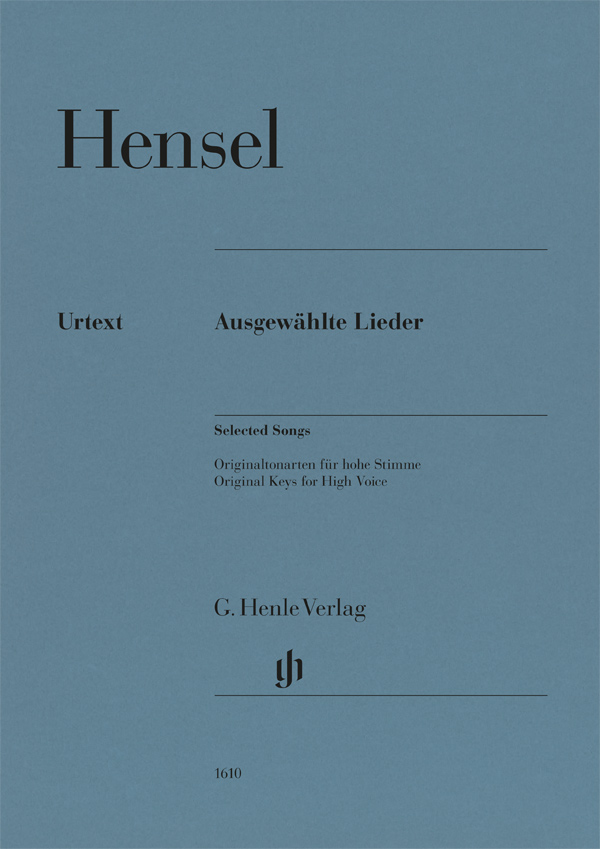
Selected Songs
ファニー・メンデルスゾーン=ヘンゼルが作曲した全450曲以上のうち、中心となるのは歌曲です。これが最大の作品群で、作曲家としての生涯、つまり初めて作品を書きとめた14歳から1847年5月に急逝する前日に書かれた最後の作品まで、彼女は歌曲に取り組みました。
G. ヘンレ社では著名な歌手ユリアーネ・バンゼと共に24曲を選びました。『Gondellied(ゴンドラの歌)』や『Warum sind denn die Rosen so blass? (どうしてバラはあんなに蒼ざめているの)』といった、存命中に出版された作品番号1番や7番の有名作品だけでなく、滅多に聴くことのできない、これまで出版物として未発表の作品を、あらゆる創作期から選びました。原典版の校訂にあたり、自筆譜だけでなく同時代の写譜や初版も研究しました。ファニー・ヘンゼル研究のスペシャリストであるアメリカのスティーヴン・ロジャースが学術的にサポートし、序文を執筆しました。
作曲家について
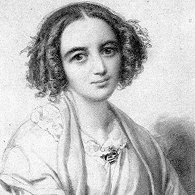
Fanny Hensel
This composer and pianist left behind a substantial oeuvre of around 460 compositions, predominantly songs and compositions for piano as well as several works of chamber music, choral music, cantatas, and an overture. Within the private milieu of the salons held in her parents’ home, she performed (and conducted) her compositions herself; they are in no way inferior to those of her brother Felix Mendelssohn Bartholdy.
| 1805 | Born in Hamburg on November 14, the eldest child of the banker Abraham Mendelssohn. |
| 1811 | Moves to Berlin. |
| 1816 | The children are baptized in the Evangelical Reformed church. Piano instruction from Marie Bigot during a stay in Paris, from Ludwig Berger in Berlin. |
| 1819 | Lessons in composition from Carl Friedrich Zelter, together with Felix; composition of songs. |
| 1820 | Joins the Sing-Akademie, led by Zelter, along with Felix and their younger sister Rebecka. |
| 1821 | First, partly public Sunday concerts take place in the Mendelssohn household. Fanny performs as pianist, later as conductor and composer. From 1831 she assumes leadership of them. |
| from 1825 | Anonymous publication of her own compositions; the songs “Das Heimweh” (1824), “Italien” (1825), and “Suleika and Hatem” (1825) are published in the volumes of her brother’s Op. 8 (1827), “Sehnsucht” (1827), “Verlust” (1828), and “Die Nonne” (1822) in that of his Op. 9 (1830). |
| 1829 | She marries the Royal Prussian court painter Wilhelm Hensel. |
| 1830 | Birth of their only son, Sebastian Ludwig Felix. Cantatas: “Lobgesang” (dedicated to her son), “Hiob” (“Job”) and “Choleramusik” (1831), “Zum Fest der heiligen Cäcilia” (1833). |
| 1831/32 | Concert aria, “Hero und Leander.” |
| 1838 | Offering of the Piano Concerto No. 1 by Felix, her only known public performance. |
| 1841 | Piano cycle “Das Jahr” (“The Year”) with pictures by her husband. |
| 1843 | Piano Sonata in G minor, which engages with Beethoven’s works. |
| 1846 | Publication of the “Six Songs for Solo Voice and Piano,” Op. 1, as the first songs published under her own name. “Four Songs for the Piano,” Op. 2, Op. 6 (1847), Op. 8 (1850), counterpart to Felix’s Songs Without Words, with bolder harmonies and greater in scale. |
| 1847 | Death in Berlin on May 14 from a stroke during rehearsals for a Sunday concert. |
校訂者や運指担当者について
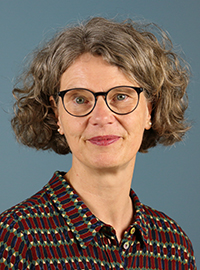
Annette Oppermann (校訂)
Dr. Annette Oppermann, born in 1965, trained as a music dealer in Frankfurt am Main and studied historical and systematic musicology as well as modern German literature at Hamburg University.
From 1993 to 1996 she worked as an editor for Sony Classical International in Hamburg; from 1996 to 1999 she was a doctoral candidate in the postgraduate programme Textkritik at the Ludwig-Maximilians-Universität in Munich, in January 2000 she earned her doctorate with a dissertation on “Musikalische Klassikerausgaben” (Hans-Joachim Marx, Hamburg). From 2000 to 2008 she worked as a research associate at the Joseph Haydn-Institut in Cologne, and was editor of the Oratorio “Die Schöpfung” in the Complete Edition of Joseph Haydn’s Works. Since February 2008 she has been an editor at Henle Publishers in Munich, with a particular focus on vocal music, chamber music and books.
製品の安全性と保証
G. Henle Verlag
製品の製造元に関する情報はこちらでご覧いただけます。G. Henle Verlag
Forstenrieder Allee 122
81476 München
info@henle.de
www.henle.com
おすすめ
autogenerated_cross_selling
このタイトルを含む他の版

このタイトルを含む他の版