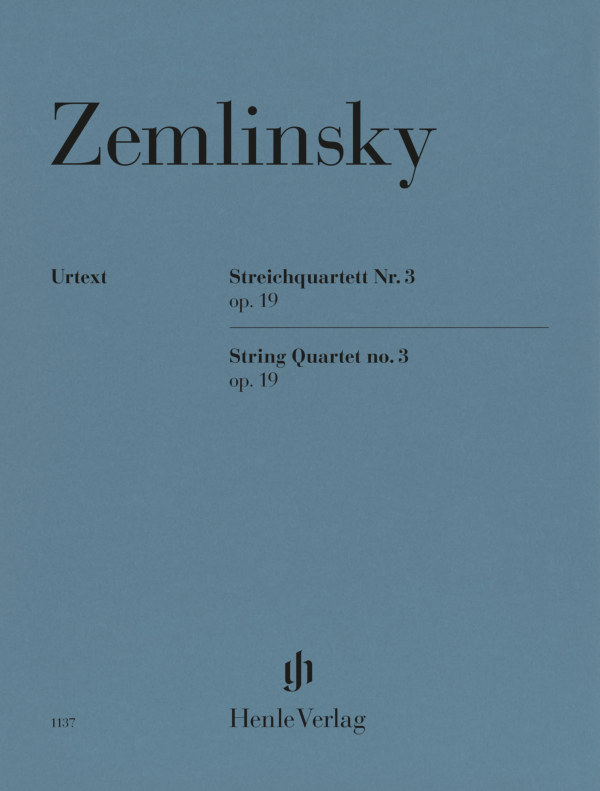
Alexander Zemlinsky
String Quartet no. 3 op. 19
オーストリアの作曲家アレクサンダー・ツェムリンスキーの弦楽四重奏は、20世紀前半、このジャンルにもっとも貢献した重要作品のひとつです。1924年に作曲された弦楽四重奏 第3番 Op. 19は、この円熟した巨匠の創造力の絶頂期を示しています。その10年前に書かれた非常に表現主義的な弦楽四重奏 第2番との差は、これ以上ないほど大きいものです。Op. 19は4楽章形式で、たびたび登場する旋律的なスタイルや皮肉なまでに冷淡な曲調など、1920年代の新古典主義の傾向を色濃く反映しています。
このヘンレ原典版のために、自筆譜のスコア、作曲家本人が校訂した版下、初版の楽譜を研究することができました。この版は最適の史料に基づいています。校訂作業において、ウィーンのアレクサンダー・ツェムリンスキー基金より大きな支援を受けました。
作曲家について
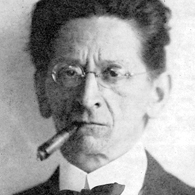
Alexander Zemlinsky
One of the most important conductors and composers of opera in the first third of the twentieth century, who attained the recognition he deserved only in the 1970s.
| 1871 | Born in Vienna on October 14. Piano instruction beginning at age 4. |
| 1884–92 | Education at the Conservatory of the Gesellschaft der Musikfreunde (Society of Friends of Music) in Vienna. Early chamber music in the style of Brahms. |
| 1895/96 | Founder and director of the amateur orchestra “Polyhymnia,” where he meets Schönberg; beginning of their friendship, though he does not pursue the path to atonality and later criticizes Schönberg’s twelve-tone technique. |
| 1900–03 | Principal conductor at the Carltheater in Vienna. |
| from 1903 | Instructor at the Schwarzwald school, where he teaches Berg, Horwitz, Jalowetz, E. Stein, and Webern. |
| 1904–06 | Composition of the opera “Der Traumgörge” (“Görge the Dreamer”). |
| 1904–11 | Music director of the Vienna Volksoper. |
| 1907 | Conductor at the Vienna Court Opera. |
| 1910 | Premiere in Vienna of his opera “Kleider machen Leute” (“Clothes Make the Man”). |
| 1911–27 | Kapellmeister at the German Theater in Prague. Engaged as instructor at the German Academy for Music and Fine Arts, as rector after 1920. Composition of the String Quartet No. 2; the Lyric Symphony, Op. 18 (1922/23); the “Six Maeterlinck Songs,” Op. 13 (1910/1913); and the Wilde operas “Eine florentinische Tragödie” (“A Florentine Tragedy,” premiere 1917) and “Der Zwerg” (“The Dwarf,” premiere 1922). |
| 1927–30 | First Kapellmeister at the Berlin Kroll Opera under Klemperer. Engaged as instructor at the Academy of Arts (choral class). |
| 1933 | Premiere in Zurich of the opera “Der Kreidekreis” (“The Chalk Circle”). Return to Vienna because of the Nazi regime. |
| 1934 | Songs, Op. 22, on poems by Morgenstern and Goethe. Political circumstances prevent his engagements; contracts previously signed are nullified on account of his Jewish heritage. |
| 1935–38 | Composition of the opera “Der König Kandaules” (“King Kandaules”), which remained unfinished (premiere in 1996, completed by A. Beaumont). |
| 1938 | Emigration to the United States. |
| 1942 | Death in New York on March 15. |
校訂者や運指担当者について

Dominik Rahmer (校訂)
Dr. Dominik Rahmer, born in 1971 in Mainz, studied musicology, philosophy and maths in Bonn. He did his Magister Artium in 1999 and his doctorate in 2006 with a thesis on the music criticism of Paul Dukas.
From 2001 to 2011 he was employed at Boosey & Hawkes/Bote & Bock in Berlin, where he also worked on the Critical Edition of the Works of Jacques Offenbach (OEK). Since 2011 he has been an editor at Henle Publishers in Munich, with a particular focus on French and Russian music and works for wind instruments.
製品の安全性と保証
Günter Henle Verlag e.K.
製品の製造元に関する情報はこちらでご覧いただけます。Günter Henle Verlag e.K.
Forstenrieder Allee 122
81476 München
info@henle.de
www.henle.com
おすすめ
autogenerated_cross_selling
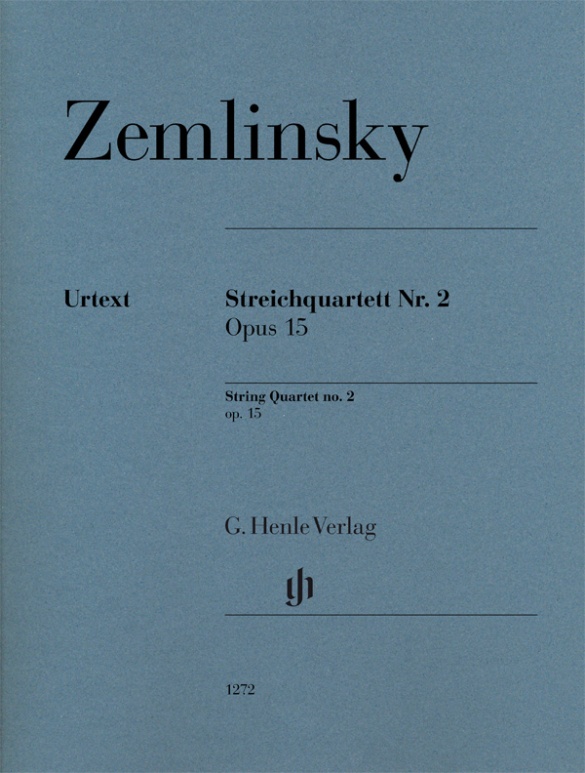
このタイトルを含む他の版
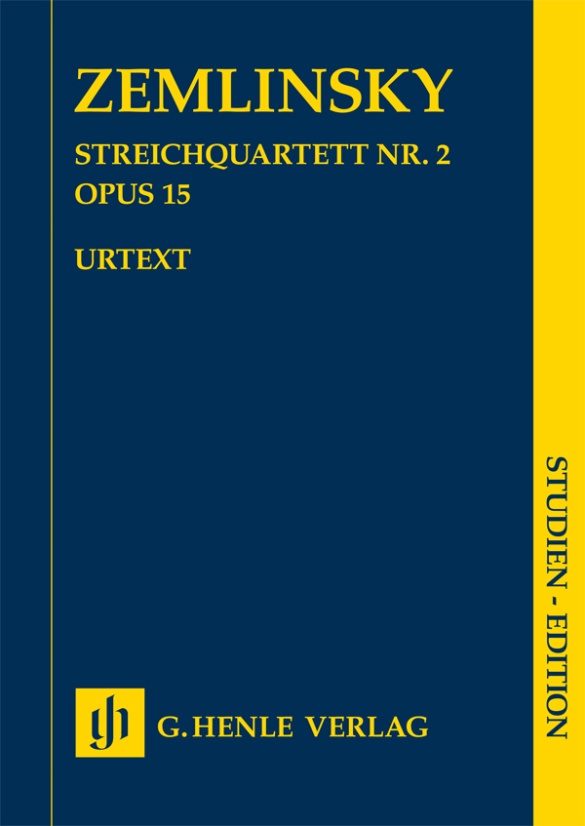

このタイトルを含む他の版