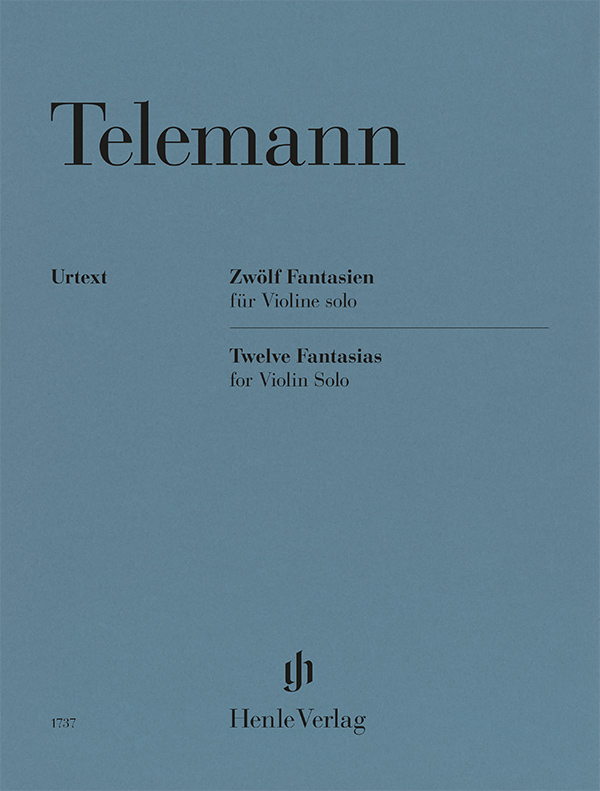
Georg Philipp Telemann
Twelve Fantasies for Violin solo TWV 40:14–25
Telemann’s instrumental works include not only charming solo concertos and lively orchestral overtures, but also a whole universe of chamber music. The three cycles with solo fantasias for flute, viola da gamba and violin form an entirely special group: within a very small amount of space, Telemann provides outstanding examples of the so-called “mixed style”, in which contrapuntal writing and melodic elements combine in a variety of ways. Since, in contrast to his colleague Johann Sebastian Bach, he makes only moderate demands in terms of technique, these fantasias for solo violin remain to this day welcome study and performance pieces for aspiring violinists.
The new Urtext edition is based only on a single manuscript copy of the work, since the first edition prepared by Telemann himself is now documented merely by a single surviving title page. The preface illuminates the performance-practice background.
Plamena Nikitassova, a specialist in her field, provides indispensable tips concerning the execution of ornamentation in this music.
作曲家について
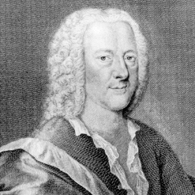
Georg Philipp Telemann
One of the leading German composers of his day, particularly as regards his German-language operas as well. Also from his pen came an extremely large number of liturgical works (especially cantatas), which came about within the context of his appointments and the compositional duties associated with them.
| 1681 | Born in Magdeburg on March 14. |
| 1701–05 | He studies law in Leipzig, but is active as a singer, librettist, and composer at the opera, and after 1702, also as its music director. He writes music for the St. Thomas Church and St. Nicholas Church. Founds a student Collegium Musicum. |
| 1704 | Organist and music director at the New Church. |
| 1705–08 | Court musical director in Sorau. |
| 1708–12 | Music director in Eisenach; composition of liturgical cantatas, masses, as well as other sacred and secular vocal works, instrumental concerti, and sonatas. |
| 1712–21 | City music director of Frankfurt am Main; composition of liturgical music and music director at the Church of the Discalced and the St. Catherine Church; reestablishment of the Collegium Musicum of the Frauenstein Society and thus the beginning of regular concert life in Frankfurt am Main. |
| 1716 | Premiere in Frankfurt of his Brockes Passion. |
| 1721 | Premiere in Hamburg of the opera “Der geduldige Socrates.” He becomes cantor at the Johanneum Latin school and music director of the city of Hamburg. The five main churches of Hamburg were thus under his musical direction. Composition of church cantatas, secular cantatas, “Captain’s Music,” instrumental music; establishment of a Collegium Musicum. |
| 1722 | He assumes the musical directorship of the Oper am Gänsemarkt (until 1738) and composes a large number of theatrical works for Hamburg. |
| 1725 | Premiere of the intermezzo “Die ungleiche Heirath oder das herrsch-süchtige Cammer-Mädgen” (‘Pimpinone’), which is still his most well-known work for the stage. |
| 1728 | Premiere of “Die Last-tragende Liebe oder Emma und Eginhard,” the most important of his surviving Hamburg operas. |
| after 1755 | Composition of vocal works in collaboration with various poets. |
| 1767 | Death in Hamburg on June 25. |
製品の安全性と保証
G. Henle Verlag
製品の製造元に関する情報はこちらでご覧いただけます。G. Henle Verlag
Forstenrieder Allee 122
81476 München
info@henle.de
www.henle.com
おすすめ
autogenerated_cross_selling
このタイトルを含む他の版

このタイトルを含む他の版